
The Financialization of Uncertainty
Prediction markets and the emergence of a new asset class

TLDR:
Prediction markets turn uncertainty into a tradable asset, where prices reflect financially backed probabilities rather than opinions.
The industry is scaling rapidly, but growth today is driven by sports, not the high value information markets that define its long-term thesis.
Crypto rails remove geographic and settlement constraints, enabling global participation and improving signal quality through scale.
Regulation determines whether liquidity concentrates into deep global markets or fragments into weaker local ones.
There is a growing gap between what prediction markets are becoming (information infrastructure) and how they generate revenue today.
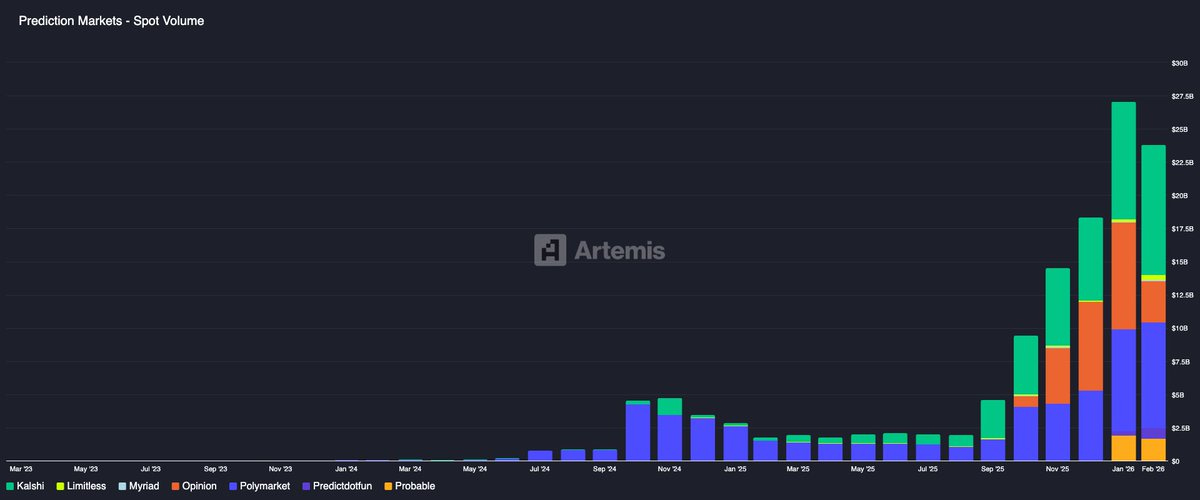
Prediction markets generated $63.5 billion in volume in 2025.
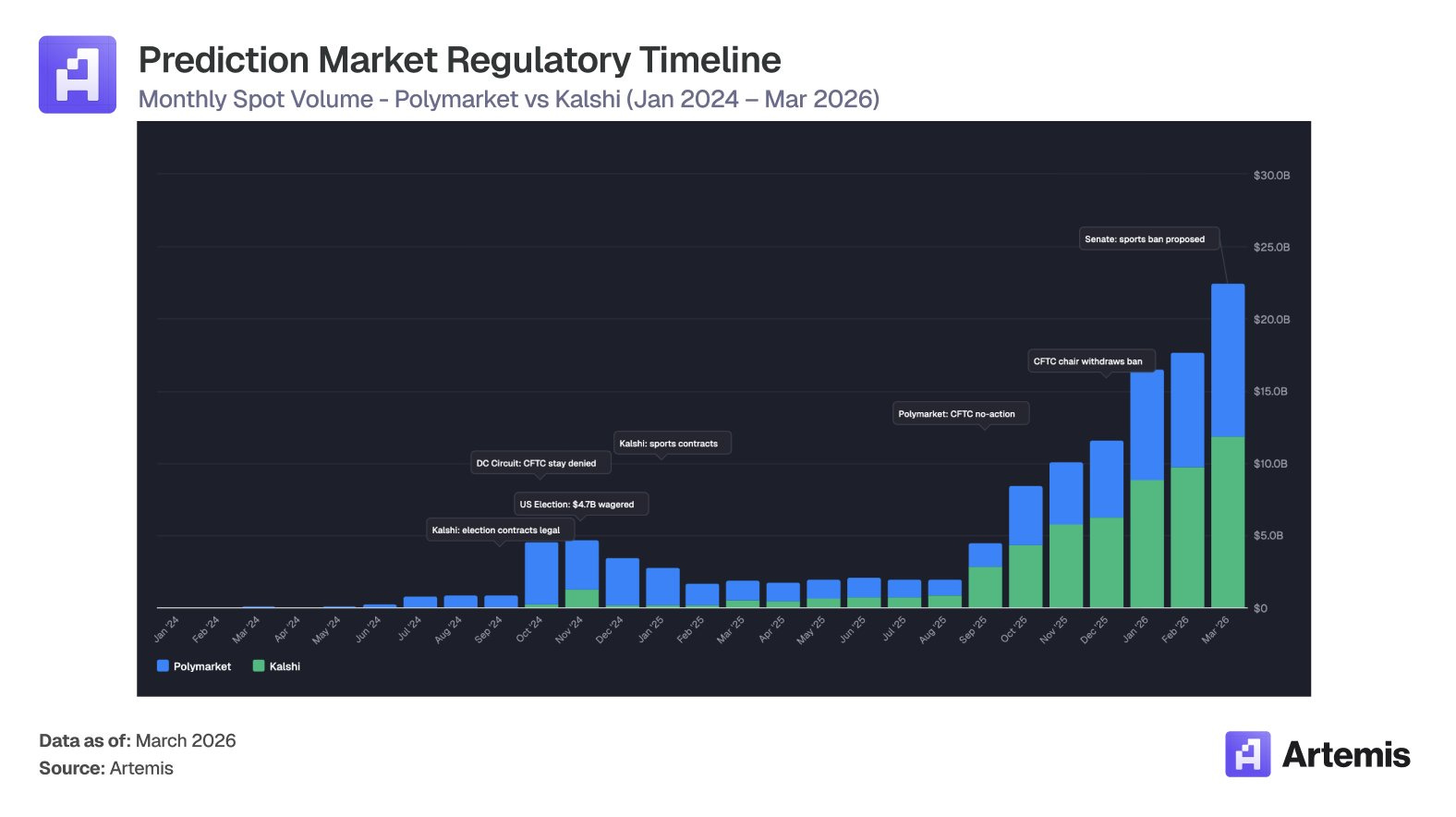
More than three times what they processed the year before. In the first 86 days of 2026, Kalshi and Polymarket alone combined for $52.7 billion, $28.3 billion on Kalshi and $24.3 billion on Polymarket (Artemis). Annualize that and you get $223 billion. The industry tripled last year and it is on pace to triple again.
Three years ago, prediction markets processed less than $100 million a month. Today they process that amount in hours. Every event – whether it’s a Federal Reserve decision, election, geopolitical escalation, or earnings outcome – can now be expressed as a market with a price. That price isn’t a forecast, but a financially backed probability that is continuously updated as new information enters the system.
Polls collect opinions, models process historical data, and analysts publish views - all of them suffer from the same structural flaw: there is no cost to being wrong, which makes accuracy effectively optional. Prediction markets get rid of that flaw by attaching financial consequences to forecasts, so that being right results in profit while being wrong leads to a direct monetary loss.
The Federal Reserve itself confirmed that prediction markets can produce more accurate and more responsive forecasts than traditional methods. In a January 2026 research paper, the Fed found that Kalshi’s prediction markets were a “statistically significant improvement” over Bloomberg consensus for forecasting headline CPI. The mode of Kalshi’s distribution perfectly matched the realized federal funds rate by the day of every FOMC meeting since 2022 (Federal Reserve FEDS 2026-010).
Why Now
Prediction markets have existed for decades. The Iowa Electronic Markets, for example, launched in 1988. Another platform called Intrade ran for years before collapsing in 2013. The underlying idea traces back even further to Friedrich Hayek, who argued that markets are the most efficient mechanism for aggregating dispersed information. While the idea was always compelling, the execution never worked due to structural constraints: limited distribution, fragmented liquidity, and slow, localized settlement. All of these have rapidly improved.
Distribution is native
Prediction markets are now being embedded directly into brokerages, media platforms, and APIs. Robinhood added event contracts alongside equities and options. Media platforms like CNN are now starting to display probabilities next to headlines and every news cycle becomes immediately actionable.
Acting on a macro view once required opening accounts, funding them, and waiting for market hours, but that friction has largely disappeared. Prediction markets are becoming a default interface for interacting with or trading on uncertainty.
Settlement is global
The second shift is more important. On traditional financial rails, prediction markets are constrained by geography, regulation, and settlement speed. But on crypto rails, those constraints disappear.
A user in New York, Lagos, or Jakarta can see the same market, the same price, and the same opportunity and make trades with effectively instant settlement times.
Prediction markets become more accurate as participation increases. Restricting markets to a single country produces structurally inferior signals. Expanding them globally improves the quality of the output. Crypto does not just make prediction markets more efficient, but makes them more truthful.
The Regulatory Dynamic
Regulation has legitimized prediction markets, but it has also exposed a clear economic conflict. Prediction markets sit at the intersection of finance and betting, and do not fit cleanly into either category. That mismatch is where the tension comes from.
This conflict is most visible in sports. States have a direct stake in sports betting. The US market processed $165 billion in 2025, generating billions in tax revenue (SportsHandle). That system was built through a state-by-state licensing process, where operators like DraftKings and FanDuel pay significant fees, partner with casinos, and operate under high tax rates (Legal Sports Report).
Prediction markets overlap with that same category but operate under a different framework. From the state’s perspective, prediction markets divert activity away from taxed sportsbooks and bypass a regulatory system that took years to build. This is why sportsbooks are pushing back. Not because prediction markets are flawed, but because they disrupt the economics of an already regulated industry.
At the same time, the CFTC is moving to regulate prediction markets, while courts decide the limits of its authority. This tension determines the end state for prediction markets. If they are pushed into a state-by-state model, liquidity will fragment. However, if they’re allowed to operate under a unified financial framework, liquidity will concentrate and prediction markets will scale into a global system for pricing uncertainty.
The Structural Risk
Today, most of the revenue in prediction markets comes from sports.
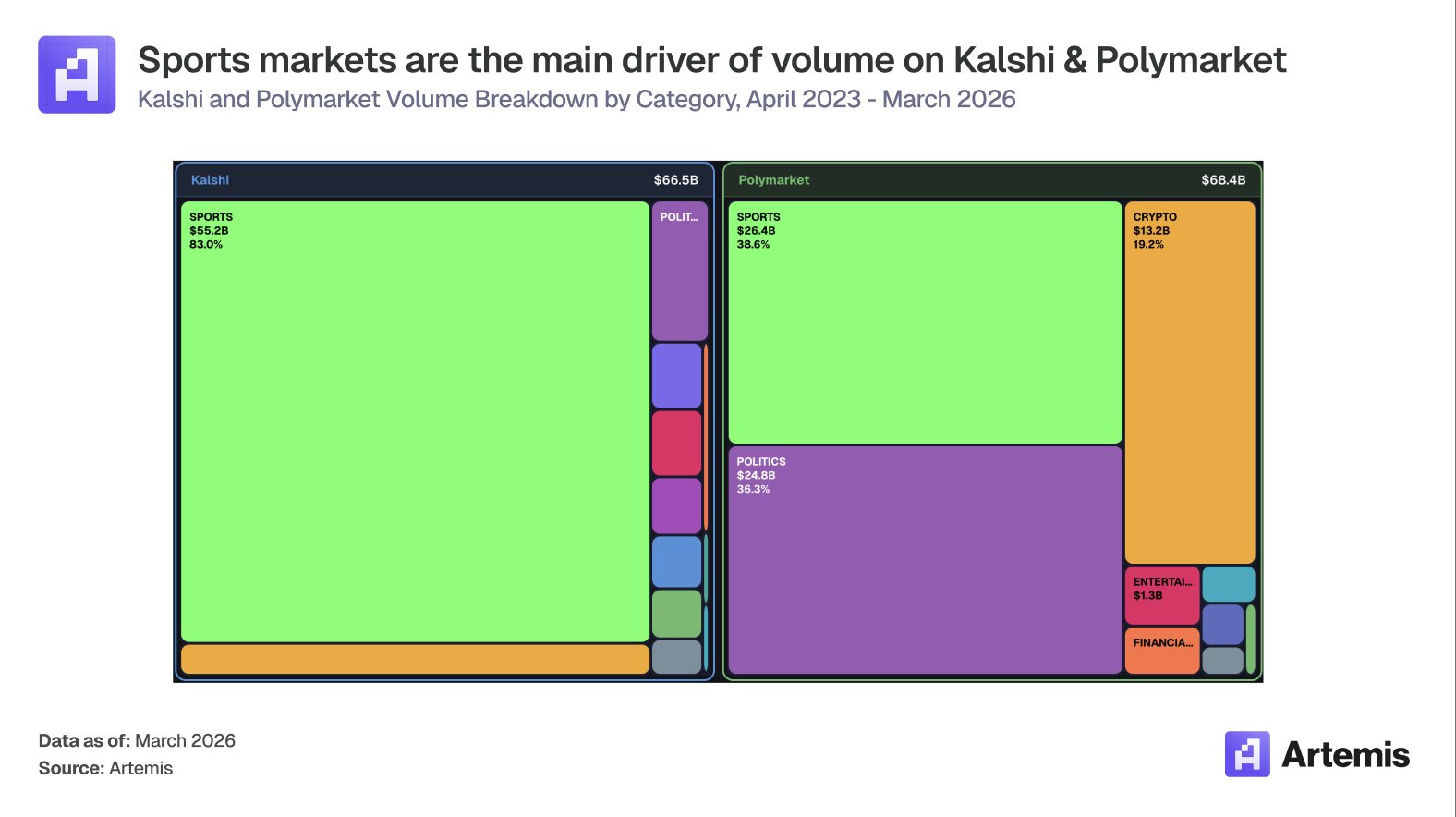
In Kalshi, sports account for roughly 83% of total notional volume. Polymarket is more diversified, but even there, sports dominates accounting for 38.4% of total notional volume. (Artemis)
This creates a clear mismatch. Current growth is driven by sports markets, which anchor perception around betting and is the one that is most exposed to regulatory pressure. As a result, the revenue base today looks much closer to sports betting than financial infrastructure.
That concentration introduces a timing risk. If regulation tightens around sports before other categories reach scale, the industry’s primary source of revenue slows before its long-term model is fully built.
Valuations, however, are clearly pricing in that future. Kalshi at $22 billion and Polymarket targeting a similar range imply a market far larger than sports betting alone, one that expands into institutional grade information markets. That transition hasn’t happened yet, which is the central tension: prediction markets are being valued as information infrastructure, but today they are still monetized like sports products.
Sports markets provide growth, but that’s not the long term moat. The real value lies elsewhere.
Where Prediction Markets Actually Win
The underlying product is real and powerful in various other categories that go beyond sports.
Politics
The 2024 election was the proof. Polymarket’s Presidential Election Winner market generated $3.7 billion in total trading volume. On the Monday before the election, Polymarket had Trump at 58% vs Harris at 42%, while traditional polls showed a dead heat (CNN). The market was right. A peer-reviewed study from IMDEA Networks Institute, analyzing 86 million bets, found Polymarket is accurate more than 94% of the time a full month before an outcome is definitively known (arXiv:2603.03136).
Prediction markets don’t replace polling but incorporate it. Polls become inputs, while prices reflect the aggregation of all information under incentives where being wrong costs money.
Economics and policy
The most important category, and where the real moat lives.
Kalshi now provides intraday trade data for macroeconomic indicators including CPI (month over month, year over year, calendar year), Core CPI, PCE inflation, unemployment, payroll releases, GDP growth, and recession probability.
The Fed’s own research validates the product. Economics and technology markets surged by 905% and 1,637% respectively in 2025. While the volumes are small today, the signal quality is already institutional grade. A market-implied probability of a rate hike is not just a data point, but it is also a signal that influences portfolio allocation, risk management, and strategic decision making at the highest levels of finance.This is where prediction markets transition from consumer product to financial infrastructure.
Why Crypto Rails Matter
The transition from consumer product to financial infrastructure depends on scale and scales with access.
Kalshi operates within the United States, a market of roughly 330 million people. Polymarket operates globally, using crypto rails to onboard users anywhere with an internet connection and a wallet. This difference changes the size of the market entirely.
A user in New York, Lagos, or Jakarta can access the same market at the same price. Participation is permissionless and distribution is effectively global. This is why crypto is a distribution advantage. Crypto also changes how markets are created. Instead of relying on centralized operators, independent resolvers and oracle systems can define and settle outcomes, allowing markets to scale far beyond what any single platform could support.
Trading venues are converging toward this model. Robinhood integrated event contracts alongside equities, options, and crypto. Around the same time, Hyperliquid launched prediction market-style contracts through HIP-4.
Market Landscape
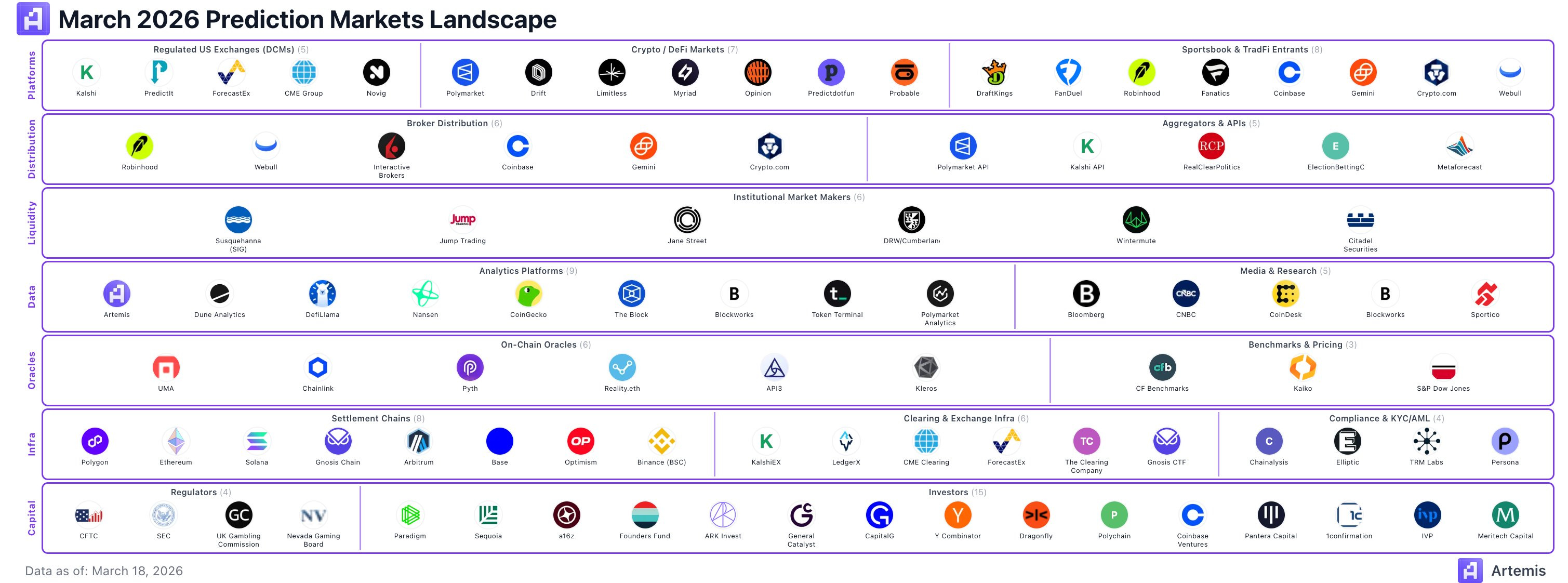
While there are many participants, the market structure has been a duopoly from the start. Kalshi and Polymarket control 97.5% of volume. What is changing is not consolidation but stratification: a clear stack is forming around these two platforms.
The Super-App Disruption
Platforms like Robinhood and Coinbase are no longer just distribution layers. They are moving into the exchange layer itself.
Robinhood has already demonstrated the demand. Prediction markets became one of its fastest-growing products, with over 12 billion contracts traded in 2025 and more than one million users. It also accounts for a majority of Kalshi’s volume which creates a clear incentive to internalize that flow. In January 2026, Robinhood acquired MIAXdx, a CFTC-licensed exchange and clearinghouse, through a joint venture with Susquehanna..
Coinbase is following the same playbook. It first integrated prediction markets through Kalshi contracts, then moved to build its own infrastructure by acquiring The Clearing Company. The strategy is straightforward: aggregate demand first, then vertically integrate. If this works, the existing market structure changes. Kalshi’s positioning relies on being the regulated exchange layer, but that advantage weakens if distribution platforms control both the user and the venue. The moat shifts from licensing to distribution.
Polymarket faces a different constraint. After exiting the US market following a $1.4 million CFTC settlement in 2022, it scaled globally on crypto rails. Its re-entry through QCEX introduces a different product, one that is more restricted, broker-routed, and fully KYCed compared to its permissionless global offering. As a result, the product that succeeded internationally is not the same one competing in the US, where incumbents already control distribution and funding rails.
This leads to a likely separation of roles. Distribution platforms control users and order flow, exchanges provide infrastructure and compliance, and crypto-native platforms dominate global access. Prediction markets continue to grow across all three layers, but value capture concentrates at the point closest to the user.
Winners and Losers
The emergence of this system creates a new hierarchy of winners.
Distribution platforms win.
Platforms like Robinhood and Coinbase sit directly in front of the user. They control onboarding, capital, and order flow. As they vertically integrate into exchange infrastructure, they capture both volume and margin. They are not just participants in prediction markets. They are becoming the primary interface.
Infrastructure providers survive, but capture less value.
Kalshi is best positioned to become the regulated backbone of the system, licensing contracts, clearing trades, and providing compliance infrastructure. But its role shifts from owning the user to servicing those who do. The model looks closer to Visa than a consumer bank.
Global crypto-native platforms remain differentiated.
Polymarket retains an advantage outside the United States, where permissionless access, instant settlement, and broader market coverage matter more than regulatory compliance. It becomes the default venue for global users, controversial markets, and crypto-native flows.
The losers are those without distribution or liquidity.
Traditional polling organizations lose relevance as financially-backed probabilities replace opinion-based forecasts. Smaller prediction market platforms struggle to compete without liquidity or embedded distribution. Sportsbooks face structural pressure as prediction markets increasingly overlap with their core product, already contributing to an estimated $600 million in lost tax revenue.
The End State
Prediction markets expand the scope of what financial markets can price. Today, markets price assets: equities represent ownership in companies, bonds represent claims on future cash flows. Prediction markets price outcomes.
Anything uncertain can become a market: political events, economic indicators, technological developments, environmental outcomes. The result is a system where uncertainty itself becomes financialized.
The numbers make the trajectory clear. 2024: ~$16 billion total volume, proof of concept via elections. 2025: ~$63.5 billion, 4x growth as sports drives scale. 2026 run rate: $200 billion+, regulatory clarity becomes existential (Artemis).
Conclusion
Prediction markets represent a shift in how the world processes uncertainty. They take something intangible, the likelihood of future events, and turn it into something that can be priced, traded, and acted upon.
The question is whether the thing that makes them valuable, pricing uncertainty, is the same thing that makes them scale. Right now, the answer is no. Sports make them scale, but information makes them valuable. The gap between those two facts is where the entire industry’s future will be decided. At scale, this is not just a new market, but a new way of pricing information itself.
Disclaimer: The authors of this content, as well as affiliates of Artemis Analytics, may have financial interests in the equities or tokens mentioned. This does not constitute investment advice or a recommendation to buy, sell, or hold any asset. The information provided is for educational purposes only and should not be relied upon for financial, legal, or tax decisions. Readers should assess their own circumstances before making any financial choices. Views expressed may change without notice, and Artemis Analytics is not liable for any losses resulting from the use of this content.*