
Artemis Weekly Digital Finance Fundamentals 2026.01.30
This week we dive into Gold vs Bitcoin, new DeFi vs Fintech piece with Lex Solokin, x402 transactions, HYPE's rebound, and Trump's new Fed Chair.


Welcome back to Artemis’ Weekly Digital Finance Fundamentals!
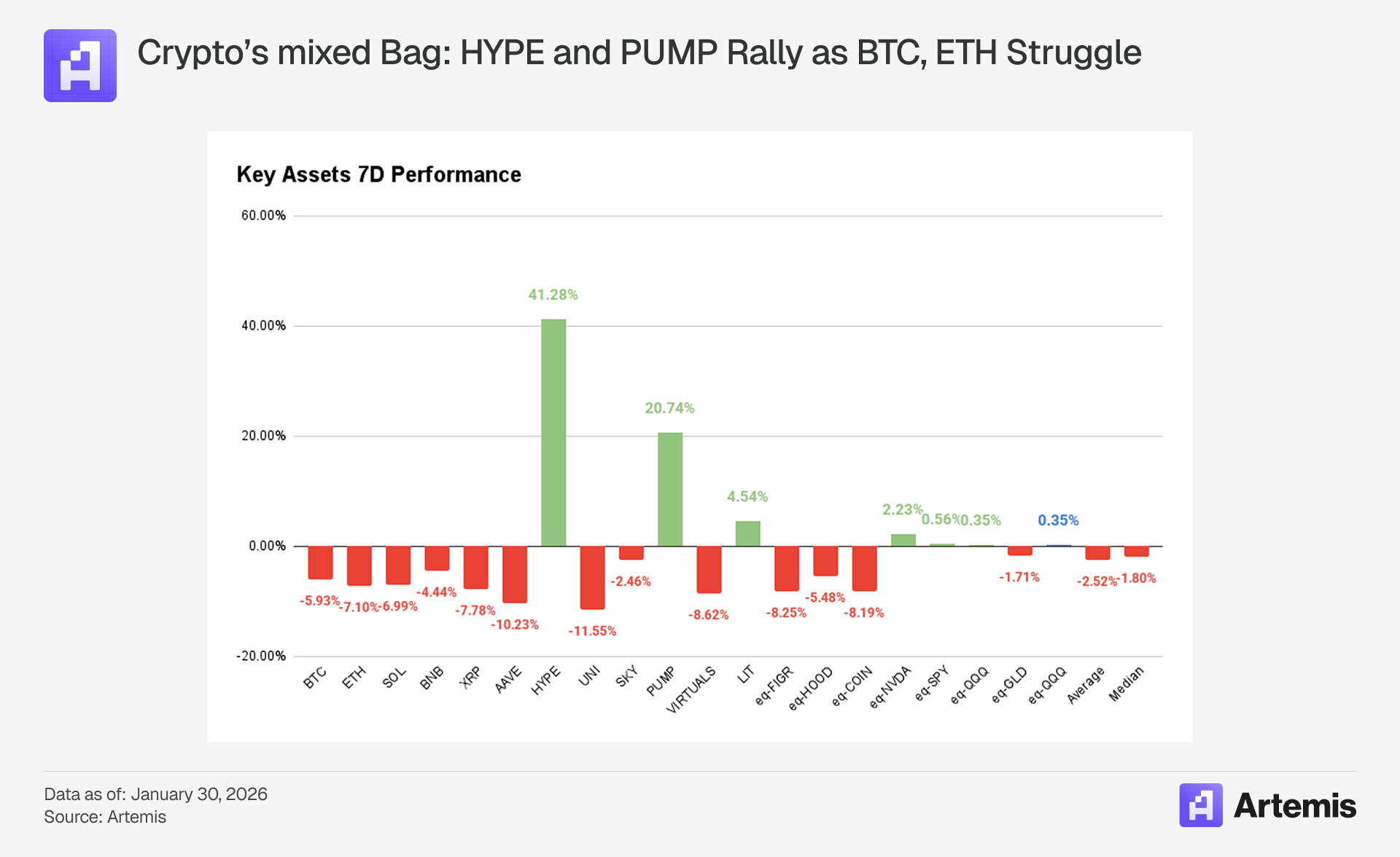
The market continues to lose momentum as majors cooled off after a strong start, with BTC and ETH drifting down ~6-7% alongside other majors, while traditional indices (SPY, QQQ) alongside Gold are largely flat.
Under the surface, dispersion remained high: HYPE exploded ~41% as there were many catalysts are lining up. Pump jumps 20% this week as onchain activity on Solana shows signs of life.
Crypto-linked equities such as COIN and HOOD continue to underperform as softer crypto trading volume and risk off sentiment weigh on risk assets.
In this weeks edition we’'ll cover:
Gold vs Bitcoin: Central banks favored gold as a sovereign reserve in 2025 while Bitcoin’s high volatility and recent liquidation cascades reinforced its role as a leveraged risk asset.
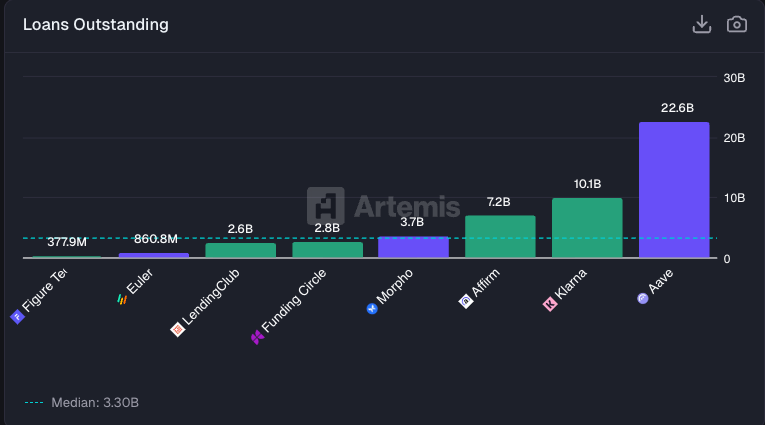
Aave: Holds over $22.6 billion in outstanding loans, effectively outscaling the combined loan books of major legacy fintech firms like Klarna and Affirm.
Hyperliquid: Reached a record $1.1 billion in HIP-3 open interest following a 54% weekly price surge and new listings on Kraken and Coinbase.
x402: Revamped flagging methodology identifies that 86% of Solana payment activity was inorganic while Base and Polygon show the strongest trends in authentic agentic commerce.
Federal Reserve: Trump nominated Kevin Warsh to lead the Fed, sparking a market selloff as investors brace for a hawkish pivot and a reduction in the central bank balance sheet.
1. Did Gold Eat Bitcoin’s Lunch?
The macro backdrop was tailor-made for the “digital gold” thesis: Trump’s tariff wars rattled global markets, central banks questioned the reliability of US assets, and fears of dollar weaponization hit fever pitch after the US floated seizing Russian reserves. This was supposed to be Bitcoin’s moment.
Instead, central banks voted for gold. China slashed its Treasury holdings by 27% since 2022 while the People’s Bank loaded up on bullion. BRICS nations collectively added nearly 800 tonnes of gold in 2025 alone, now controlling over 6,000 tonnes (roughly 20% of global central bank reserves). For the first time since 1996, gold accounts for a larger share of central bank reserves than US Treasuries.
The logic is simple: gold can’t be frozen via SWIFT, it carries no counterparty risk, and it carries no dependency on the Trump administration that’s been souring relationships with all countries - allies or not. Bitcoin, despite sharing many of these properties on paper, still trades like a leveraged tech bet and October’s $19B liquidation cascade proved it.
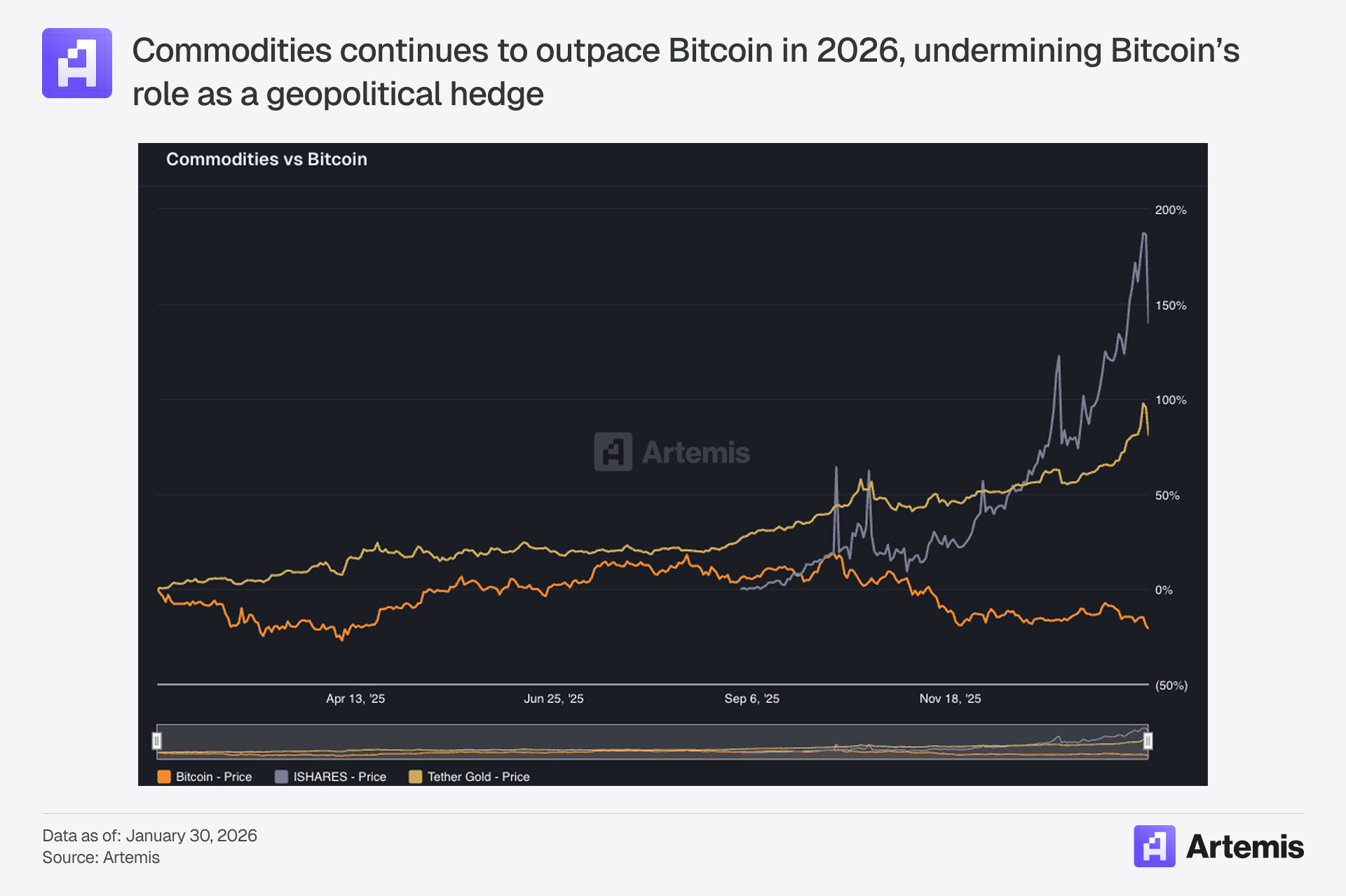
The bearish case for Bitcoin is getting harder to ignore. This week alone saw $1.68B in liquidations (93% longs), nearly $1B in ETF outflows in a single session, and BTC sliding to $81K as Kevin Warsh’s Fed chair nomination odds surged. The Crypto Fear & Greed Index sits at 34, options markets are pricing less than 5% odds of revisiting all-time highs this year, and demand for downside protection at $80K is surging. When fear dominates, it seems that institutions still default to assets with centuries of track record, not 16-year-old assets with high volatility.
That said, Bitcoin’s story isn’t over. El Salvador, Texas, Arizona, and New Hampshire are all building BTC reserves. It’s also still quite early in the life of Bitcoin. Central bankers are still trying to wrap their head around what the asset is and what it has to offer. The governor of the South African central bank said he doesn’t trust the “private issuers of Bitcoin”.There’s still a long way to go for Bitcoin, but its role as a decentralized asset that lies outside the jurisdiction of private powers is more important than the world thinks. Find the Commodities vs Bitcoin chart here:
2. Research & Article Spotlight
Are on-chain protocols finally outscaling legacy fintech? In our latest piece with Lex Sokolin: Is Fintech or DeFi a better financial system, we analyze the capital flows, revenue models, and user metrics between onchain protocols and fintechs.
The most striking takeaway? The lending protocol Aave currently holds over $22,6 billion in outstanding loans, which is more than the combined loan books of major fintech companies like Klarna and Affirm. While Klarna and Affirm focus on providing credit to retail consumers for shopping, Aave operates as a wholesale liquidity layer for on-chain financial activity. This distinction highlights how DeFi can operate at a larger scale than traditional players.
Find the Artemis Comparables Dashboard here:
3. HYPE surges ~54% in 1 week
Last week was a massive turning point for Hyperliquid ($HYPE). The token surged approximately 54% over the last 7 days, hitting highs of around $34 after a period of consolidation.
HIP-3 Expansion & Commodity Mania
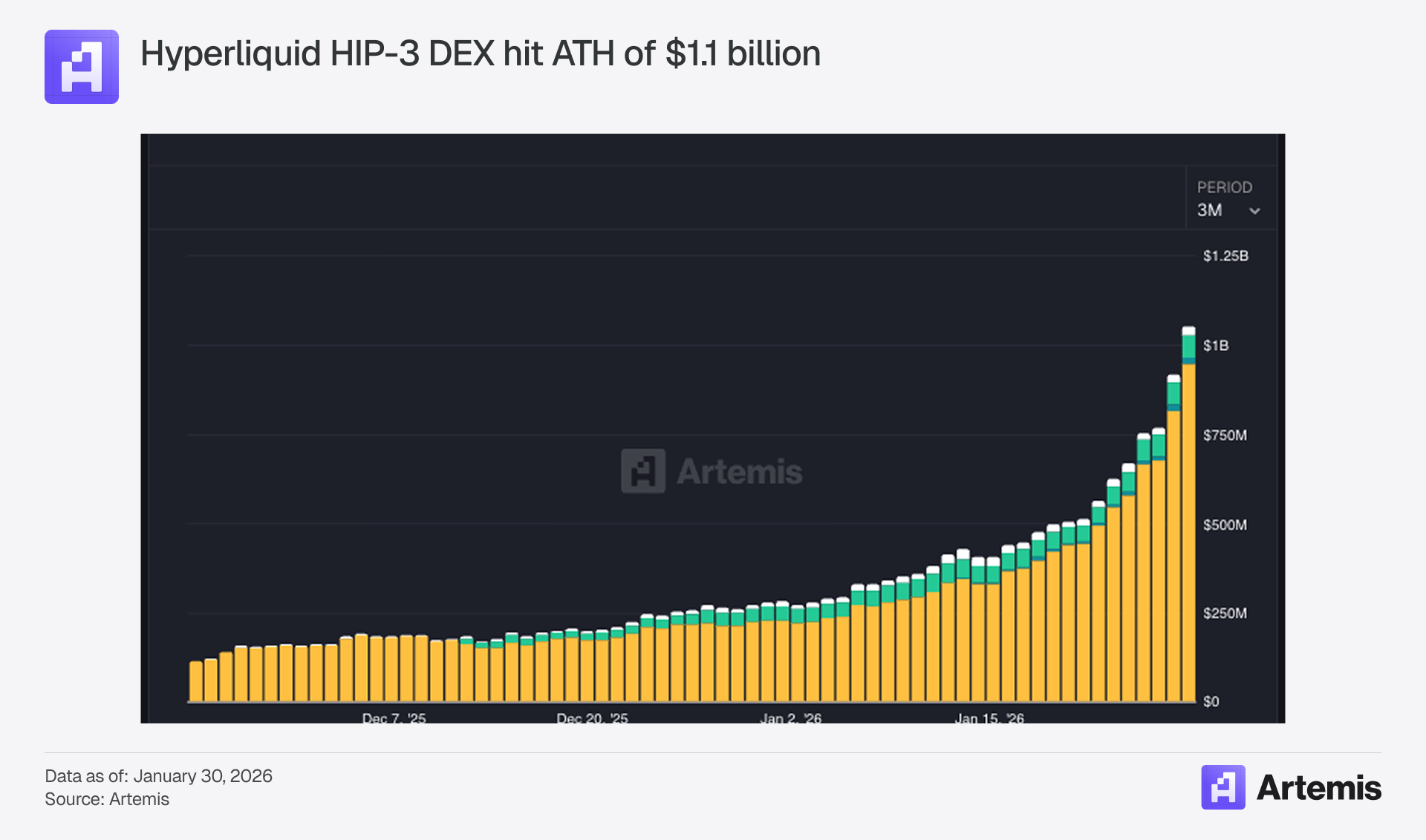
The launch of HIP-3 (Builder Deployed Perpetuals) has transformed Hyperliquid from a crypto DEX into a global “everything exchange.”
ATH Volume & OI: HIP-3 Open Interest (OI) hit an all-time high of $1.1 billion this week.
Commodities Drive: With traditional commodities hitting multi-year highs, Hyperliquid became the go-to venue for tokenized Silver and Gold perps. Silver alone saw massive volume hitting over $1.5 billion in daily volume.
The Tier-1 Exchange
Nothing fuels a surge like liquidity access. Within 48 hours, $HYPE became 10x more accessible to investors through listings on CEXes.
Kraken Listing: Spot trading for $HYPE/USD and $HYPE/EUR went live on January 28, 2026, opening the floodgates for retail and fiat-onramp buyers.
Coinbase Roadmap: Coinbase officially added $HYPE to its listing roadmap on January 29, 2026, triggering a massive “Coinbase Effect” rally as investors front-run the full listing.
4. X402 transaction gaming still runs rampant today
Over the past several months, attention surrounding agentic commerce has been growing quickly. We’ve been analyzing the onchain activity for these types of payments, specifically focused on the x402 payment standard, which allows you to attach a stablecoin to a web request.
As these metrics gain prominence, they often fall victim to Goodhart’s Law – “when a measure becomes a target, it ceases to be a reliable indicator.” As the space gains momentum and attention, participants do their best to climb leaderboards for attention and users.
Our revamped methodology for flagging gamed activity revealed that 86% of Solana’s all-time x402 activity was “gamed.” Additionally, Base has demonstrated the most consistent legitimate activity and Polygon is showing real strides in authentic growth
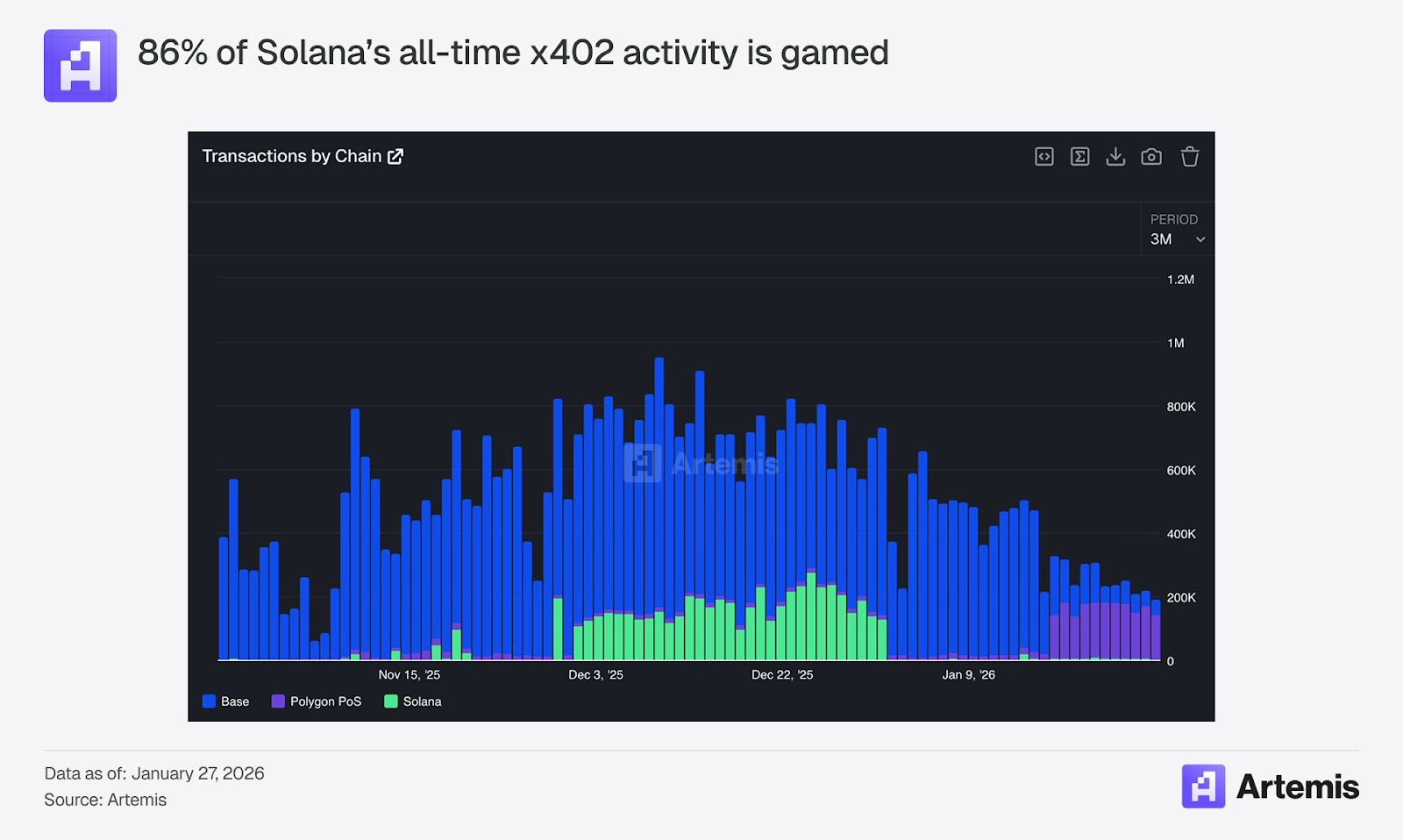
For the x402 standard to achieve institutional-scale adoption, the industry must prioritize transparency. Distinguishing between the noise is essential for identifying the builders moving the space forward. We revamped our methodology for identifying genuine activity which you can check out here:
5. New Fed Chair Has Markets Spooked
The Senate Agriculture Committee voted 12-11 along party lines to advance the “Digital Commodity Intermediaries Act” – the first time crypto market structure legislation has ever cleared a Senate committee. The bill would establish CFTC authority over digital commodities like Bitcoin and Ethereum, finally resolving the years-long turf war between regulators. If passed, it would give exchanges, brokers, and institutions the clarity they need to fully engage with crypto markets. The bill now needs to clear the Senate Banking Committee, which remains stalled over the stablecoin yield fight between Coinbase and the banking lobby.
Meanwhile, SEC Chair Paul Atkins and new CFTC Chair Mike Selig held a historic joint “harmonization” event, announcing the re-launch of “Project Crypto” as a joint policy initiative. The agencies committed to aligned definitions, coordinated oversight, and allowing tokenized collateral like Bitcoin and USDC.
On Friday, Trump officially nominated Kevin Warsh to replace Jerome Powell as Fed chair, confirming what prediction markets had priced in overnight. BTC dropped to $81K as the news broke. Warsh’s reputation as a monetary policy hawk has markets down. He’s known for prioritizing inflation control, favoring higher real interest rates, and advocating for a smaller Fed balance sheet.
While Bitcoin has historically thrived in easy-money environments with expanding Fed liquidity, Warsh wants the opposite. He called the Fed’s balance sheet “bloated” and argued it has “subsidized Wall Street” while squeezing Main Street. His anti-QE stance could reshape the liquidity environment that’s supported risk assets since 2008.
Charts of the Week
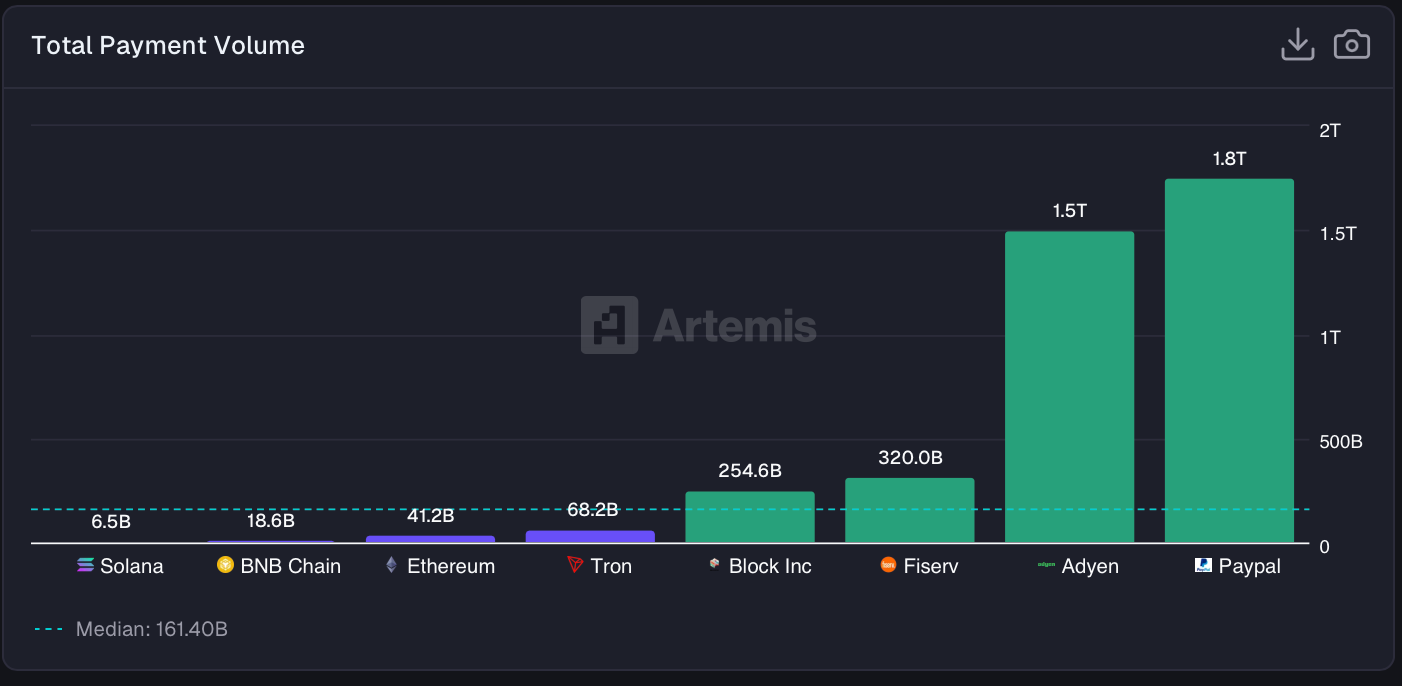
Traditional fintech companies dominate Total Payment Volume against crypto
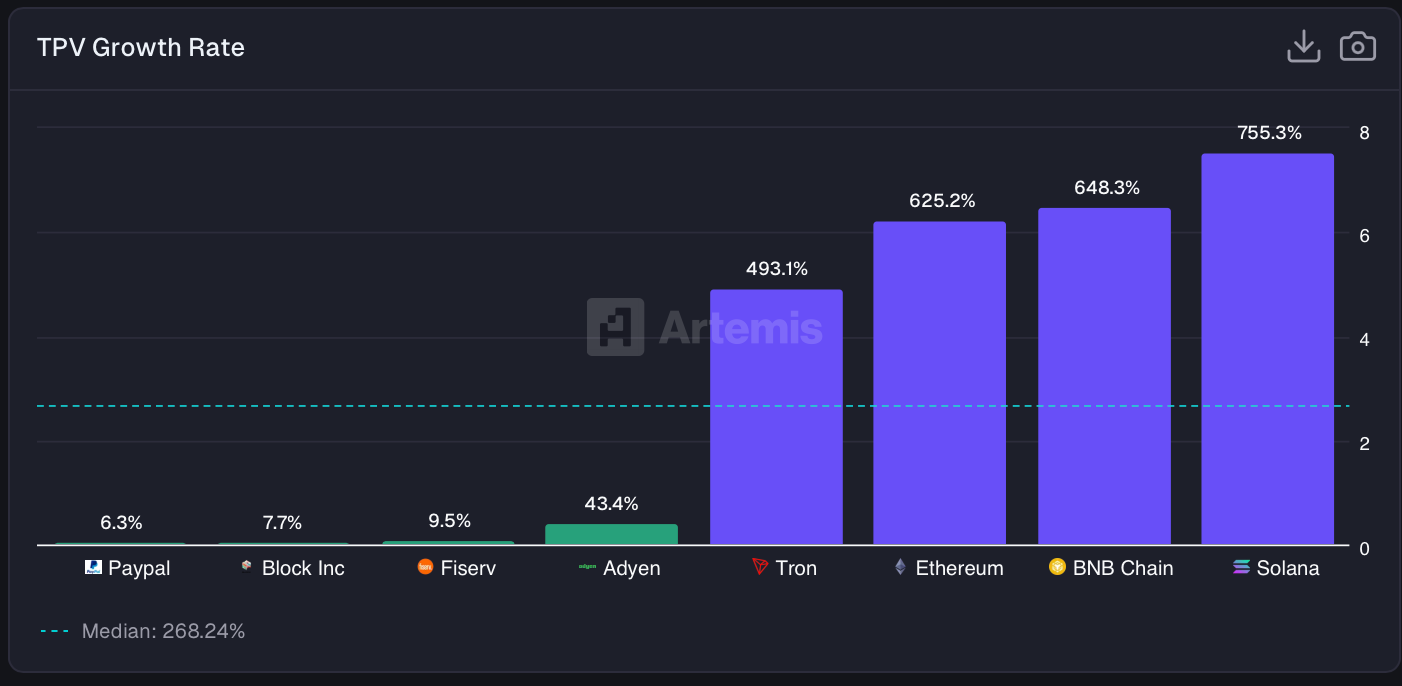
However, crypto completely changes the narrative when looking at growth rates
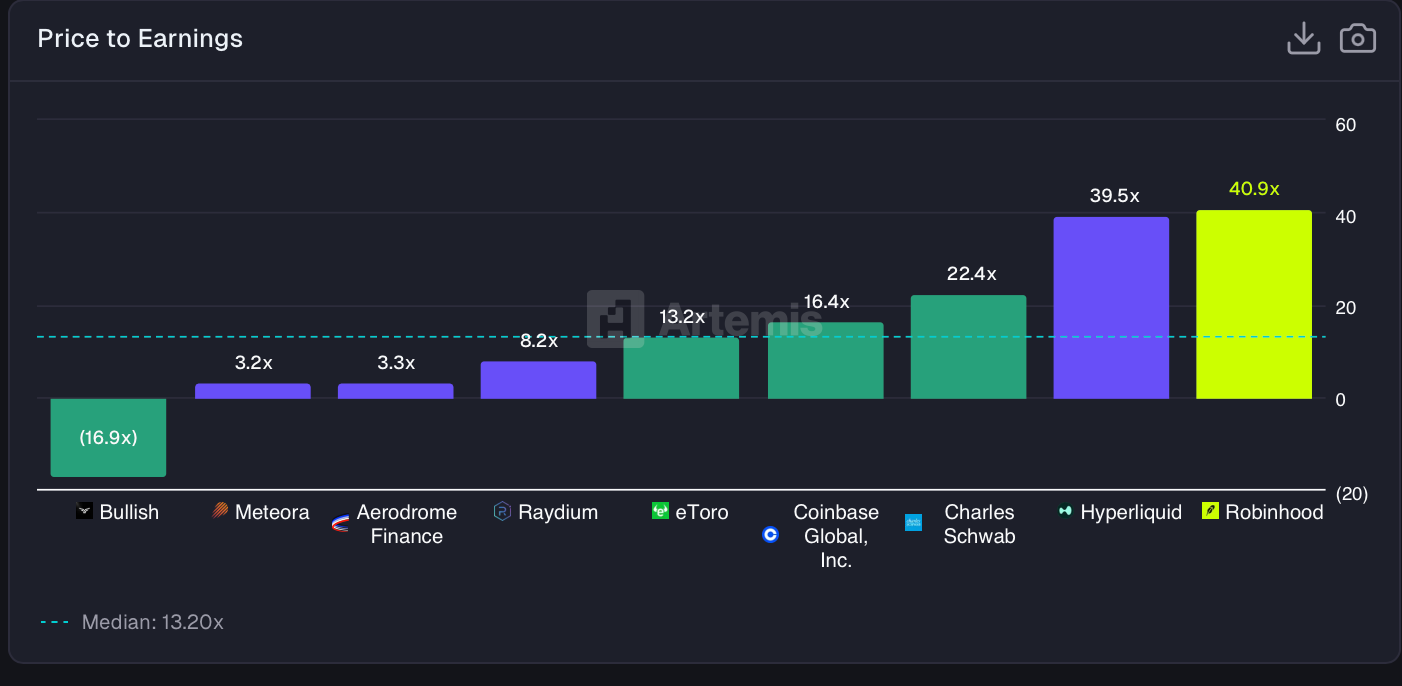
Robinhood and Hyperliquid trade at the same P/E ratio
Thanks for reading! Stay ahead this week by using the Artemis Terminal or pulling live data with =ART() in Excel.
Disclaimer: The authors of this content, as well as affiliates of Artemis Analytics, may have financial interests in the protocols or tokens mentioned. This does not constitute investment advice or a recommendation to buy, sell, or hold any asset. The information provided is for educational purposes only and should not be relied upon for financial, legal, or tax decisions. Readers should assess their own circumstances before making any financial choices. Views expressed may change without notice, and Artemis Analytics is not liable for any losses resulting from the use of this content.
 | A guest post by
|