
Artemis Weekly Digital Finance Fundamentals 2026.03.20
This week we cover Hyperliquid's continued ecosystem growth, the launch of Tempo Mainnet and more!

Welcome back to Artemis’ Weekly Digital Finance Fundamentals!
Market Overview: The Weekly Recap
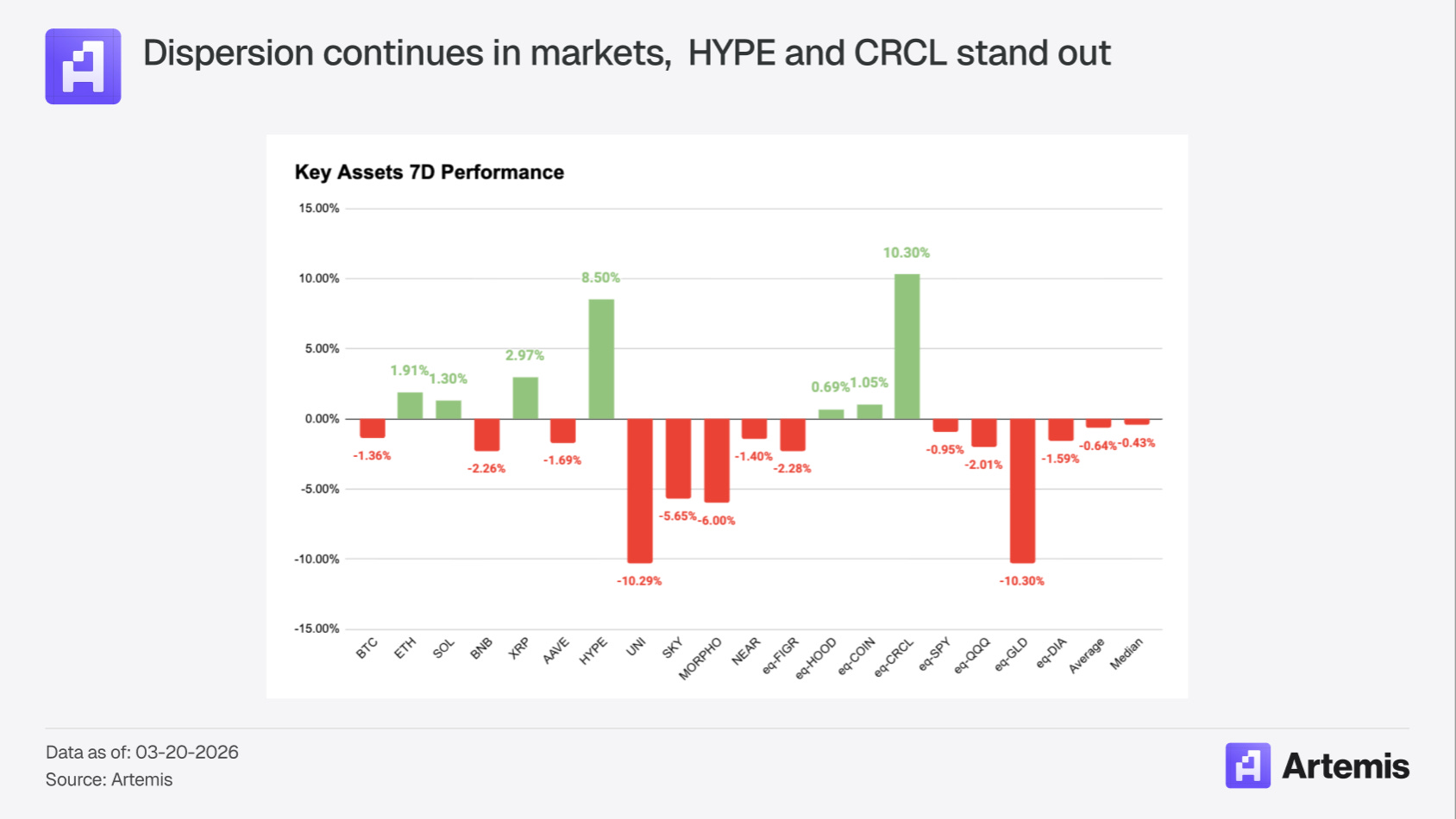
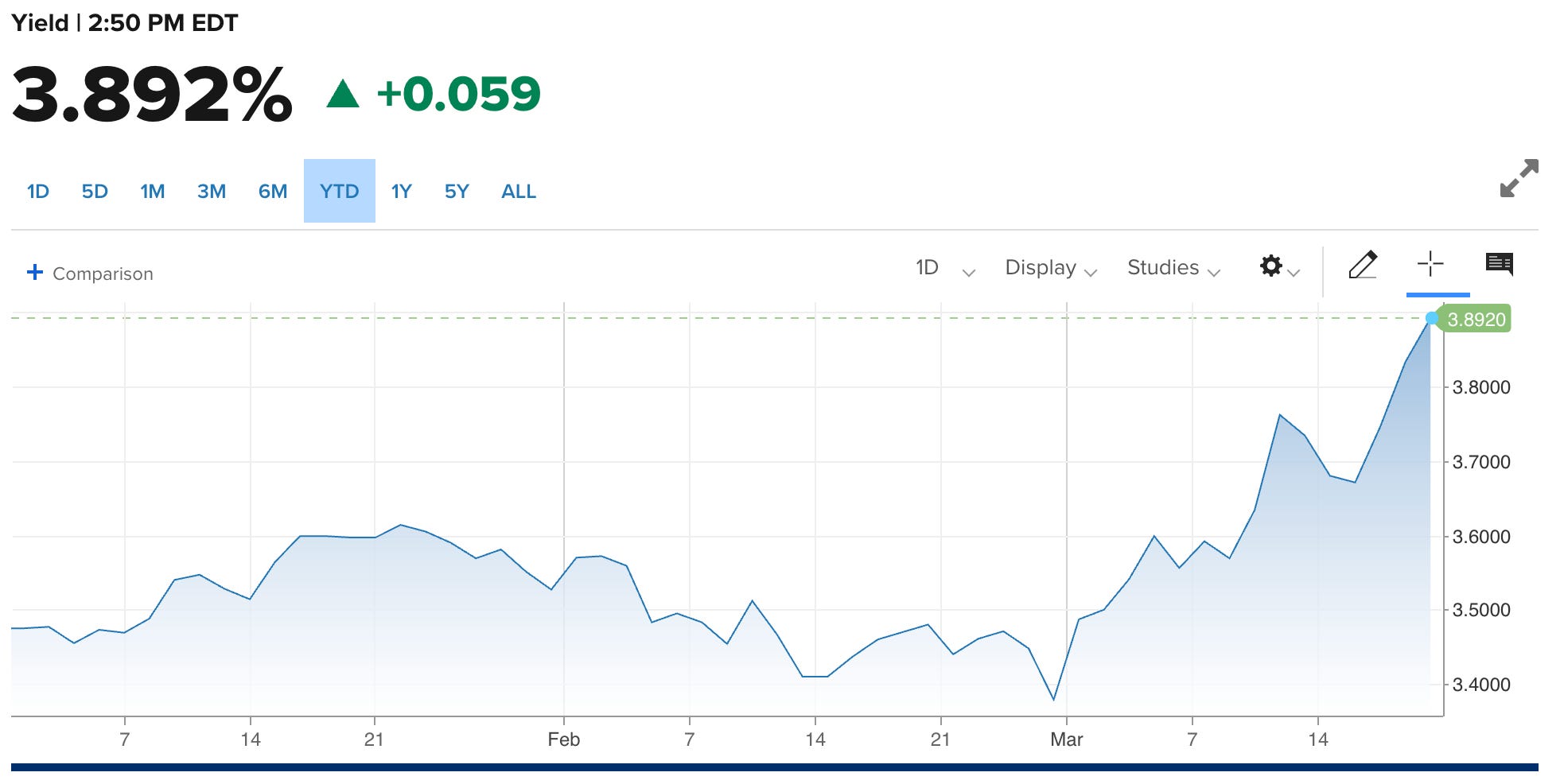
This week, dispersion continued, with clear winners in HYPE and CRLC (up 36% and 100% in the past month, respectively). The mean return across key assets was a negligible -0.3%, reflecting that even though there were winners this week there were also significant losers, with macro continuing to be the major factor. Gold has been retracing as 2 year treasury yields have sharply inflected to 3.9%, up from 3.7% earlier in the week. Gold now sits 13% below highs printed in early March, while silver is 37% below its January highs. The moves in bonds and commodities are direct outputs of the escalating war in the Middle East. The S&P500 ended the week down 2.52%, including a -1.5% move on Friday following announcements that the Pentagon is seeking a $200bn budget for the war, and is considering deploying additional troops (Politico).
Today We Highlight:
HIP-3 Updates: SP500 partnership, Crude trading, HYPE rerating
CFTC and SEC put forward new guidance amid CLARITY Act delays
Tempo Mainnet goes live, announce MPP
1. Hyperliquid ecosystem growth continues with S&P partnership
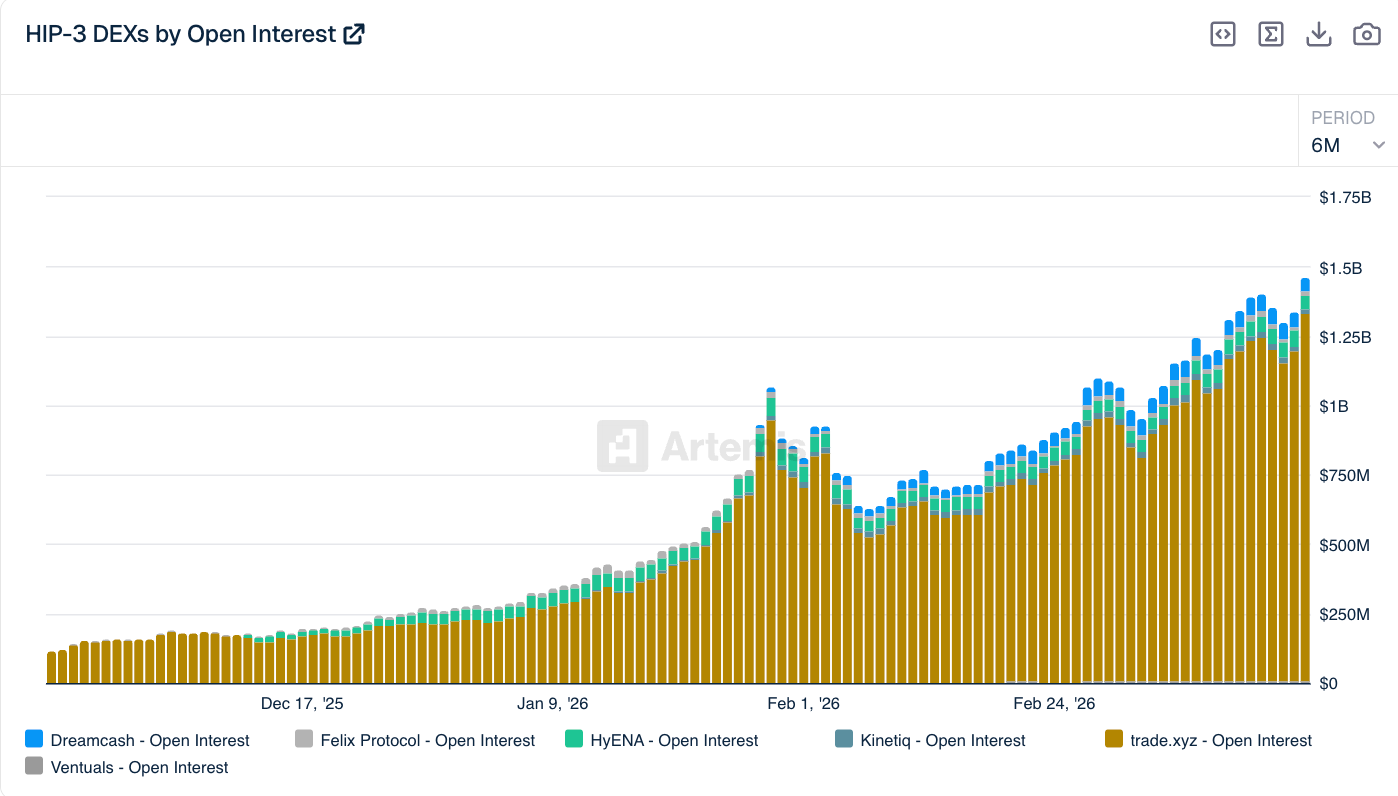
Hyperliquid has continued to remind us that great products work regardless of market sentiment. HYPE has gapped up +50% from $26 to $39 in the past several weeks, as HIP-3 markets have reached all-time highs in open interest and have emerged as a leading venue for trading commodities and macro assets outside traditional market hours.
Growth in HIP-3 markets is primarily coming from the XYZ protocol which makes up ~85% of open interest. Further driving this momentum is the announcement that trade[XYZ] has partnered with S&P to launch the first official S&P 500 perpetual contract. This means that trade[XYZ] will now operate the first and only S&P500 perpetual future contract, “enabling 24/7 onchain access to the world’s most iconic benchmark” (S&P Global Press Release).
The economics of HIP-3 markets are as follows: the deployer of the market must lock up 500k HYPE, users experience 2x the standard fee, and Hyperliquid receives 50% of that fee, with the rest going to the operator.
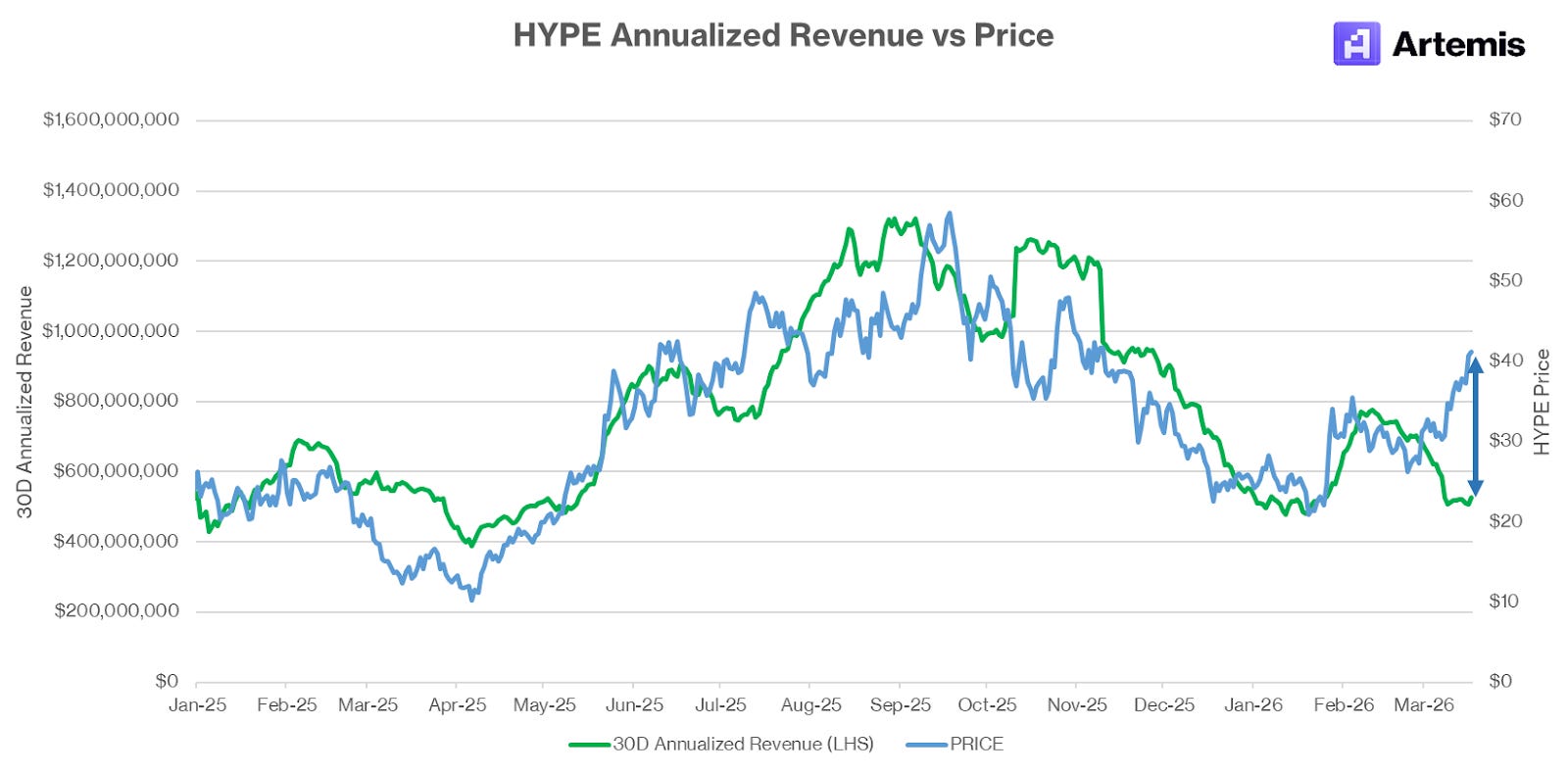
HYPE’s recent rerating indicates the market is valuing it on significantly higher revenue multiples, as we are seeing price and revenue diverge. Historically, we have observed price and annualized revenue exhibit significant comovement, and instances of divergence tend to be short lived. Given HIP-3's trajectory, we believe revenue is more likely to catch up to price than the reverse.
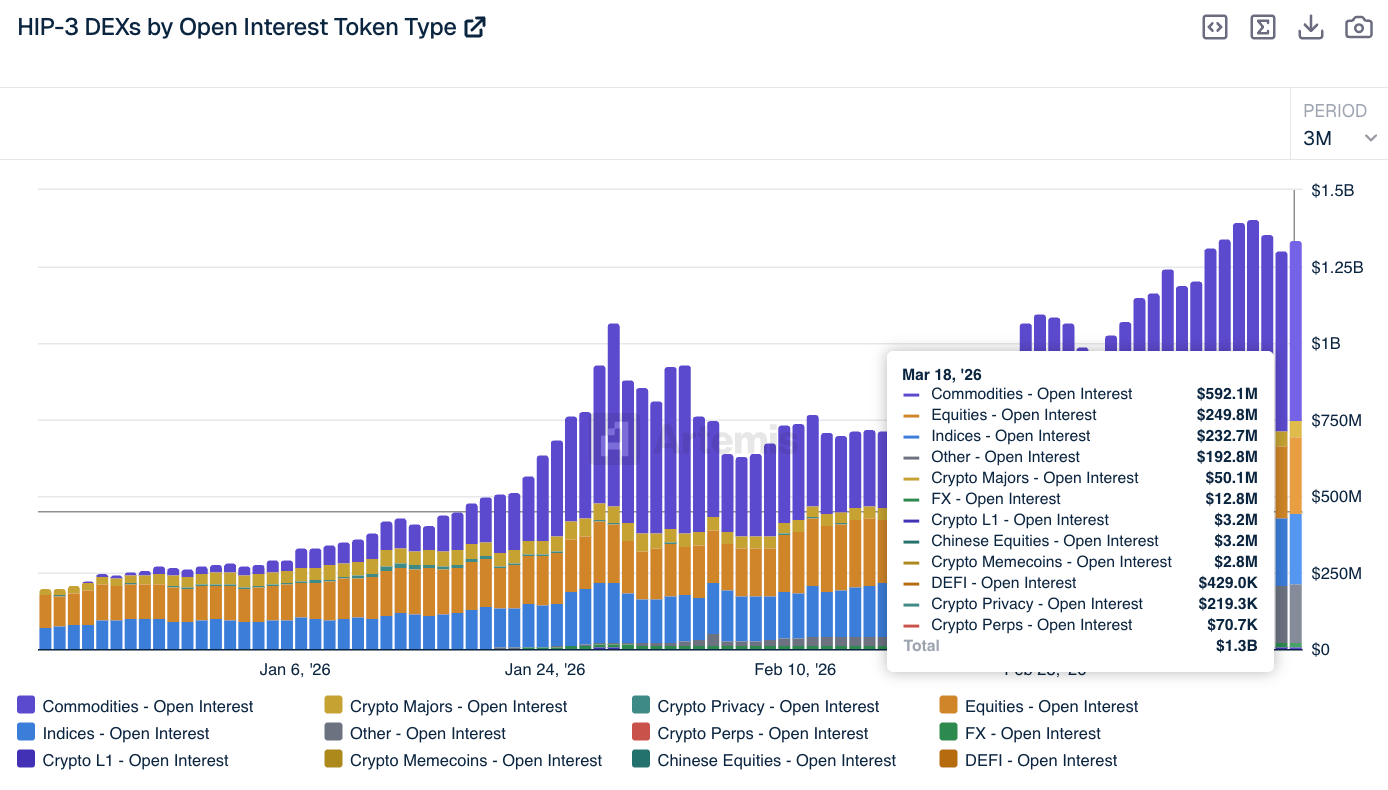
The valuation growth can be explained by the higher future earnings potential of the protocol given the success of HIP3 markets and the diversification of assets being traded on the platform. One major criticism of protocol revenues in DeFi is that they are highly cyclical, tied to the price of bitcoin, and therefore of lower quality. Commodities, equities and indices make up >80% of trading volume on HIP 3 markets, largely driven by speculation due to the war in the Middle East and other macro events. Hyperliquid is challenging the DeFi narrative by bringing onchain the trading of assets uncorrelated to the price of bitcoin. Because of this, it deserves to command higher multiples on better quality revenue.
2. CFTC and SEC put forward new guidance amid CLARITY Act delays
“We are not the securities and everything commission anymore” said SEC Chairman Paul Atkins during his speech at the DC Blockchain Summit. On March 17th, the CFTC and SEC released what is possibly the most consequential US digital asset regulatory document ever issued. As chairmen Selig and Atkins said, the intent is for this to act as a bridge until the CLARITY Act is enacted.
What is it?
The 68-page guidance, issued by the SEC and endorsed by the CFTC, provides a taxonomy for crypto assets unlike any we’ve seen before. The taxonomy, at a high level, is as follows:
Digital Commodities: Primarily includes L1 assets like ETH, AVAX, APT, but also includes SHIB which is a memecoin, and DOGE.
Digital Collectibles: This category primarily includes NFTs like Crypto Punks, Chromie Squiggles, but also includes WIF which is a memecoin.
Digital Tools: A category inclusive of blockchain-based representations of assets with practical functions like tickets, memberships, credentials, or identity badges.
Stablecoins: Covers stablecoins as defined under the Covered Stablecoins definition given in Staff Statement on Stablecoins, until GENIUS goes into effect, at which point it adopts the definition used therein.
Digital Securities: Any assets that are traditional securities tokenized on a blockchain, plus tokens that qualify as investment contracts under Howey. Importantly, the guidance introduces the “attach and detach” concept — a token can start as a digital security and graduate out of that classification once the issuer fulfills its promises or the network decentralizes.
Why is this important?
Since the inception of crypto assets, there has not been a clear regulatory framework for digital assets in the United States. This has led to the offshoring of digital finance innovation, and the SEC performing “regulation by enforcement” on US-based companies (see Uniswap, Coinbase, etc.). By issuing this guidance, the US allows operators to innovate more comfortably and effectively, with much better understanding of where the boundaries are. While this guidance is extremely important, it is interpretive, not statutory. This means that it has not yet been fully codified into law, and a future, less-crypto friendly commission could rescind or reinterpret this guidance.
3. Tempo launches Mainnet, announces Machine Payments Protocol (MPP)
Stripe is one of the internet’s most dominant payments processors, valued at $158bn as of February 2026, and processing nearly $2 trillion in payments volume in 2025 - surpassing incumbent PayPal for the first time. This week, as interest in agentic commerce and payments continues to accelerate, Stripe finally launched their Tempo Layer 1 blockchain on mainnet, alongside the launch of their agentic payments protocol: Machine Payments Protocol.
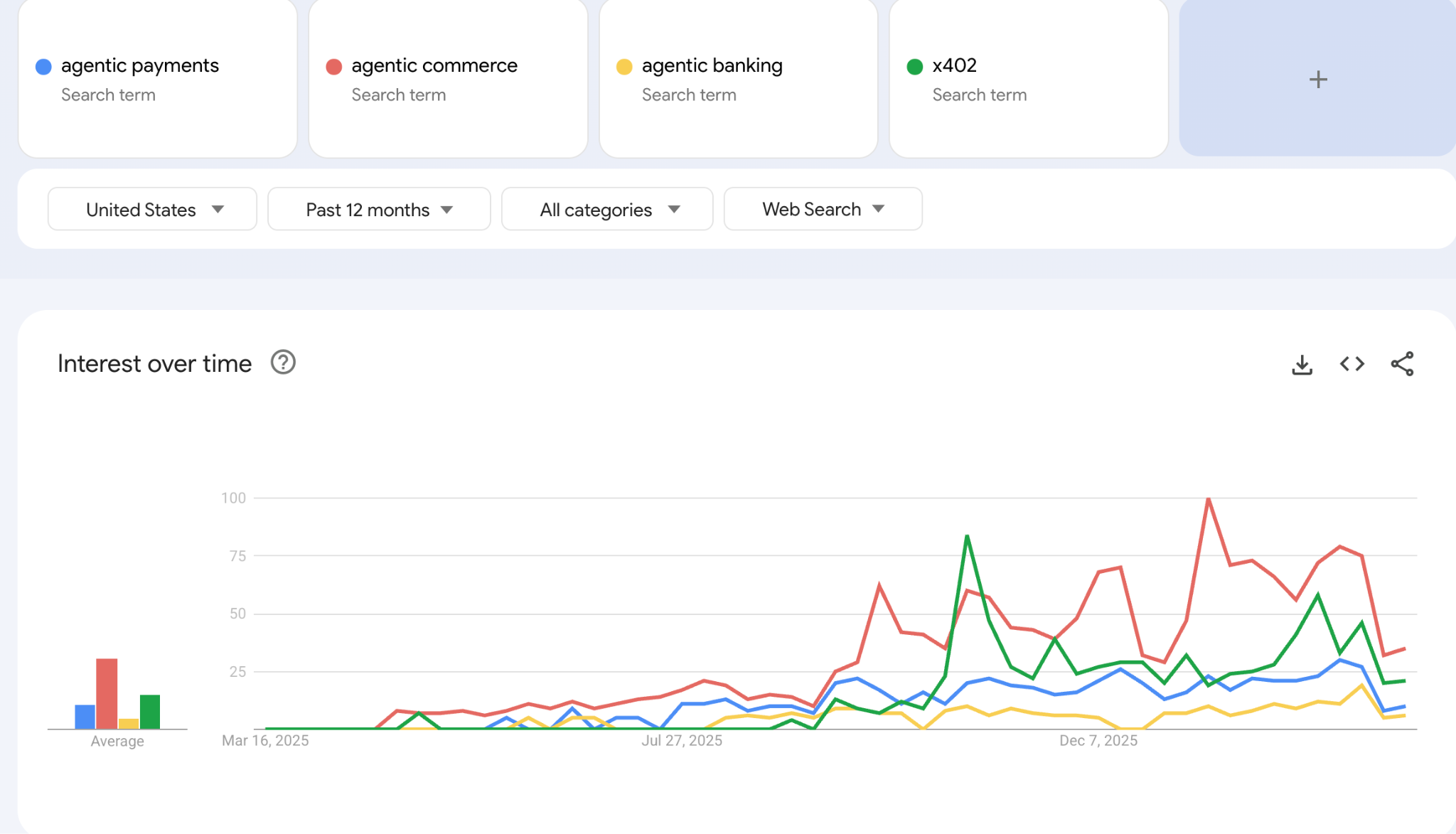
Interest in topics relating to agent to agent commerce has risen dramatically over the past 6 months, and x402, a protocol spearheaded by Coinbase has become the most popular choice for developers. While x402 provides a crypto native mechanism for agentic payments, MPP extends this framework and allows for payments on traditional payment rails like credit cards or wallets.
So what?
Stripe has been betting big on crypto since their October 2024 $1bn acquisition of Bridge. Since then, they have also acquired Privy, a major crypto wallet infrastructure business, developed Tempo, their own Layer-1 blockchain purpose built for payments, and added crypto to Stripe checkout. With the announcement of MPP, it’s becoming clear that Stripe is becoming more than just a payments processor for businesses, it is building the payments layer that will power commerce for all of digital finance - on or off chain. Stripe already processes payments for millions of businesses worldwide — meaning MPP doesn't need to build distribution from scratch. Any merchant already on Stripe's rails can plug into agentic commerce without touching crypto infrastructure, a moat x402 simply doesn't have.
Charts of the Week
2 Year Treasury yields spike amid Iran war and macroeconomic volatility
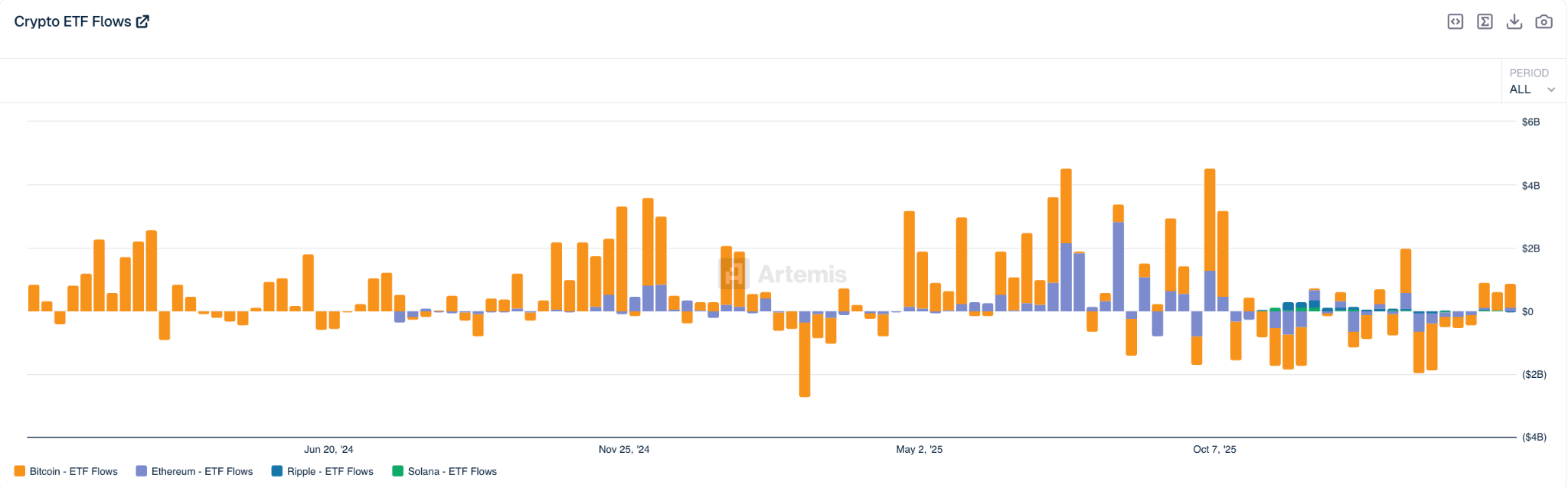
Crypto ETF Flows have been positive for the past 4 weeks, the first time this has happened since July 2025. March is shaping up to be the first month of positive net flows since October 2025. (Note the weekly aggregation in the chart below does not include the current period)
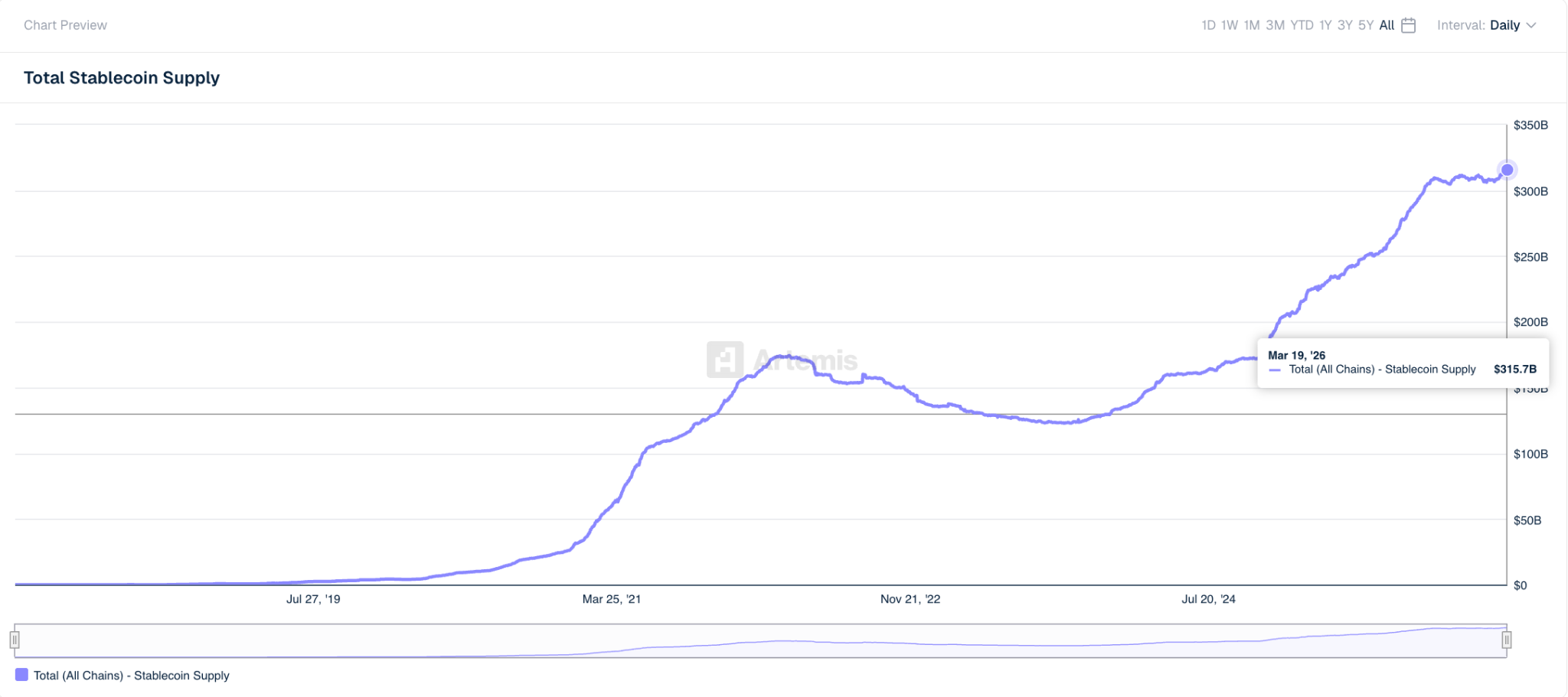
Stablecoin supply makes new all time highs this week at >315bn
Other Notable News
Key senators may have finally come to terms on how to deal with stablecoin rewards in the CLARITY Act, though this is yet unconfirmed at the time of writing (Politico).
Figure announced Figure Forge, a tokenization service that converts real-world assets like auto loans into fungible “Participation Tokens” usable as collateral within DeFi protocols (X/mcagney).
Mastercard acquires stablecoin startup BVNK for $1.8bn (Reuters)
Kalshi raises $1bn at $22bn led by Coatue, doubling valuation from December’s raise (Bloomberg).
Thanks for reading! Stay ahead this week by using the Artemis Terminal or pulling live data with =ART() in Excel.
Disclaimer: The authors of this content, as well as affiliates of Artemis Analytics, may have financial interests in the protocols or tokens mentioned. This does not constitute investment advice or a recommendation to buy, sell, or hold any asset. The information provided is for educational purposes only and should not be relied upon for financial, legal, or tax decisions. Readers should assess their own circumstances before making any financial choices. Views expressed may change without notice, and Artemis Analytics is not liable for any losses resulting from the use of this content.